

24/08/2012
|
Porcine
3
What is your diagnosis? (3)
Six months old, mixed breed pig with widely distributed eritematous skin lesions . Particulalry abundant in the ventral region, limbs and ears.
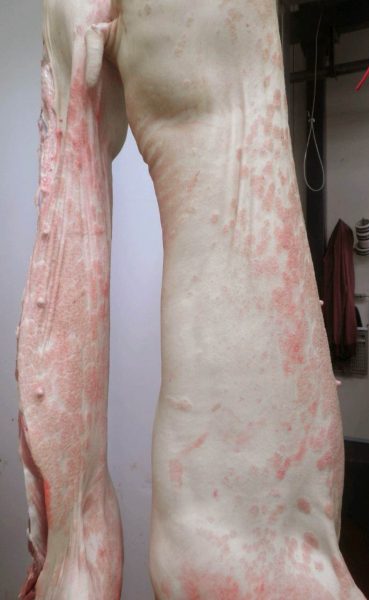
Widely distributed, oval shaped, eritematous lesions.
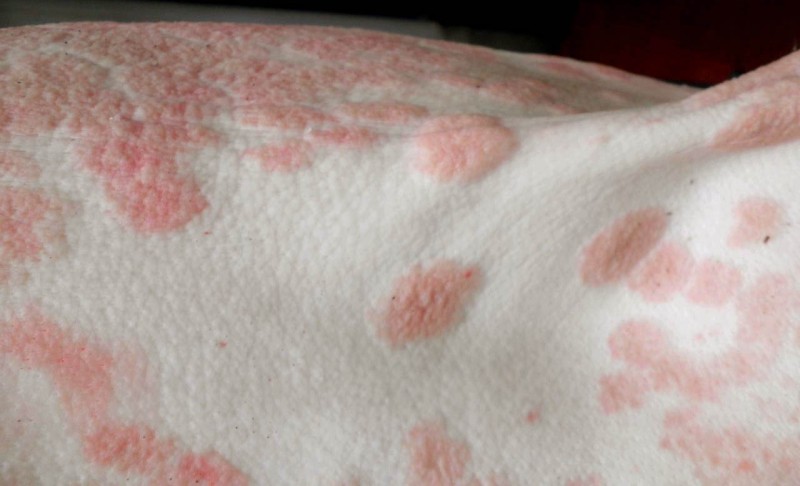
Detail of the lesions, oval in shape and coalescent.
[poll id='7']

3 comment(s)
Histopathology confirmed the presence of lesions of a psoriasiform pustular dermatitis also known as Pityriasis rosea.
From 38 answers a 53% got the right diagnosis. The second most voted was Porcine dermatitis and nephropathy syndrome (26%) followed by Erysipelas (13%) and, fianlly the cutaneous mastocytoma (8%).
Here you can check previous posts in this blog related to the same differential:
https://sesc.cat/lesions-cutanies-hemorragiques/?lang=en
https://sesc.cat/mastocitoma-cutani-en-una-canal-de-porc/?lang=en
El estudio histopatológico confirmó que se trataba de una dermatits pustular psoroasiforme o Pitiriasis Rosea.
De 38 respuestas un 53% ha acertado el diagnóstico. La segunda opción mas votada ha sido la de la dermatitis i nefropatía porcina (26%) seguida por el Mal Rojo (13%) y, finamente, el mastocitoma cutáneo (8%).
Podéis consultar anteriores entradas del blog en relación a este diagnóstico diferencial:
https://sesc.cat/lesions-cutanies-hemorragiques/?lang=es
https://sesc.cat/mastocitoma-cutani-en-una-canal-de-porc/?lang=es
L’estudi histopatològic va confirmar que es tractava d’una dermatitis pustular psoriasiforme o Pitiriasi Rosea.
De 38 respostes un 53% ha encertat el diagnòstic. La segona opció més votada ha esta la del síndrome de dermatitis i nefropatia porcina (26%) seguida pel Mal roig (13%) i, finalment, el Mastocitoma cutani (8%).
Podeu consultar entrades anteriors en aquest blog on es descriu el diferencial per aquestes malalties:
https://sesc.cat/lesions-cutanies-hemorragiques/
https://sesc.cat/mastocitoma-cutani-en-una-canal-de-porc/