

Annual summary 2025
During 2025, SESC has managed a total of 118 inquiries. Of these, 12 were online inquiries and the remaining 106 corresponded to requests for laboratory analysis of samples.
Below we present a summary of this year's data. We take the opportunity, once again, to thank the collaboration and effort of the pathologists and experts in animal health from both the IRTA-CReSA, the SDPV and the Faculty of Veterinary Medicine of the UAB as well as the staff of the Public Health Agency of Catalunya (ASPCAT), especially to the official meat inspectors who, with their contributions, make the success of this page and this service possible.
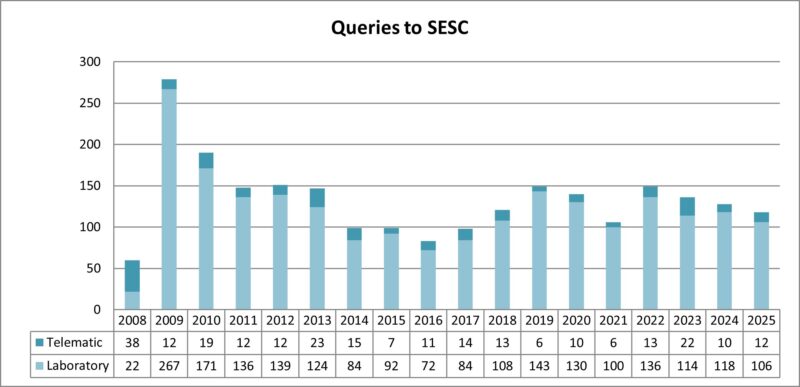
Evolution over the years of the number of queries submitted to SESC.
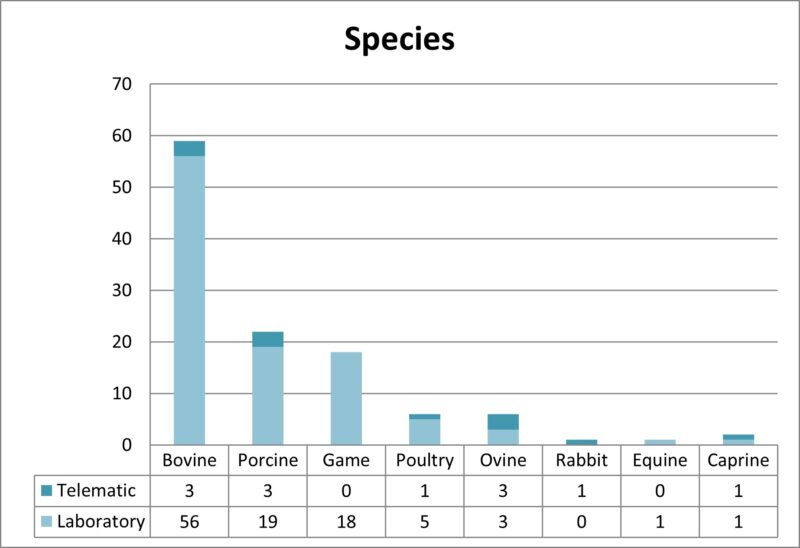
Distribution by species of queries received at SESC. The bovine sector, once again, is the one that provides the most samples, especially for the confirmation of diagnosis of zoonoses such as tuberculosis and bovine cysticercosis. As in previous years, game meat queries have increased, in particular for wild boar, mainly due to the confirmation of findings compatible with tuberculosis lesions.
The last quarter of 2025 was marked by the first introduction in Catalonia and Spain of Lumpy Skin Disease (LSD) and by the reintroduction of African Swine Fever (ASF). Anticipating this scenario, the SESC placed special emphasis this year on notifiable diseases. This was driven by a request from AESAN to deliver a seminar on the detection of Category A notifiable diseases in slaughterhouses. This work was also used to expand the blog with posts on notifiable diseases. In addition, beyond potential emerging notifiable diseases, we published content aimed at showing Official Veterinary Services (OVS) the most characteristic lesions observed in outbreaks of both LSD and ASF, as this group plays a key role in the passive surveillance of these diseases.
A key milestone this year was the launch of the training section within the user area, where OVS have permanent access to the presentations from the training courses delivered.
Regarding casework, 118 cases were managed, 90% of which corresponded to laboratory testing requests. Notably, 1,569 samples were analysed through the bovine tuberculosis eradication programme, resulting in four positive TB diagnoses. Consultations related to game animals were also maintained, especially wild boar, for the detection of tuberculosis-compatible lesions, with 18 confirmed tuberculosis cases in hunted wild boar. However, once again, submissions of non-tuberculous granulomas in domestic species remained below target (only 28 bovine granulomas, far from the 100 proposed to meet MAPA objectives, and again no suspicions in small ruminants). It is important to stress that slaughterhouse surveillance remains a key component in achieving the eradication of animal tuberculosis, particularly in domestic reservoirs not subject to eradication programmes. In this regard, a guideline was also published this year to refine lymph node sampling in bovine tuberculosis suspects, with the aim of maximising the likelihood of confirming the diagnosis in vivo.
Also noteworthy is the publication of two new factsheets in the Diagnostic Atlas and 20 new blog posts, a key tool for training and scientific dissemination.
Table 1: Summary of suspected notifiable diseases and zoonoses reported by submitting veterinarians, as well as other diagnosed conditions.
| SUSPICION AND DIAGNOSES | |||||||||||||||||||||||||||||||||||
| SUSPICION | Nº of queries | % of suspicion confirmation |
DIAGNOSES (Summary) | ||||||||||||||||||||||||||||||||
| TB compatible lesions* | 46 queries
(53 animals) |
39.62% (21/53) |
|
||||||||||||||||||||||||||||||||
| Cysticercosis comaptible lesions | 12 | 33.33% (4/12) |
|
||||||||||||||||||||||||||||||||
| ASF/CSF compatible lesions *** | 6 | 0%
(0/6) |
|
||||||||||||||||||||||||||||||||
| Summary of suspicions of notifiable diseases and zoonoses from veterinarians who sent samples and other processes that have been diagnosed (there are consultations that may have more than one animal).
*This classification includes samples received in which, although the inspector did not suspect TB, the lesion was macroscopically compatible. **The TB diagnoses correspond to 3 cattle with LCT (3 confirmed CMT) and 19 wild boars with LCT (18 confirmed CMT PCR/culture, 1 as CMA). ***In all cases, the infection was ruled out by molecular diagnosis (PCR) and histopathological study. This year, 23 cases of diseases included in the WHO list of diseases have been diagnosed: · TB 21 · Lumpy skin disease 2 (5 animals) |
|||||||||||||||||||||||||||||||||||
Table 2: Summary of diagnoses and number of consultations (some consultations may include more than one animal).
| Classification | Diagnoses (summary) | Frequency |
| Infectious | TB | 18 |
| n= 33 | Granulomatous lymphadenitis/pneumonia due to Nocardia spp. | 3 |
| Lumpy skin disease | 2 | |
| Orf | 2 | |
| Abscessing hepatitis and esplenitis (Trueperella pyogenes) | 1 | |
| Colibacilosis + Marek's disease | 1 | |
| Bronchopneumonia due to Mycoplasma bovis + Pasteurella multocida | 1 | |
| Gangrenous myositis (Clostridium perfringens and Trueperella pyogenes) | 1 | |
| Granulomatous lymphadenitis due to Rhodococcus equii | 1 | |
| Disseminated Fusobacterium necrophorum | 1 | |
| Erysipelas | 1 | |
| Possible porcine circovirosis | 1 | |
| Inflammatory | Eosynophilic myiositis | 6 |
| n=37 | Granulomatous lymphadenitis (no isolation) | 6 |
| Interstitial hepatitis (possibly toxic) | 2 | |
| Myocardial abscess (no isolation) | 2 | |
| Lymphoid hyperplasia | 2 | |
| PDNS | 2 | |
| Bacterial pyielonephritis | 2 | |
| Fibrinous-necrotizing bronchopneumonia | 1 | |
| Bronchitis, peribronchitis and bronchiectasies | 1 | |
| Fibrinous pleuropneumonia | 1 | |
| Granulomatous pneumonia (no isolation) | 1 | |
| Suppurative bronchopneumonia + periportal hepatitis | 1 | |
| Arthropodes bite dermatitis | 1 | |
| Ulcerative suppurative dermatitis | 1 | |
| Follicular gastritis | 1 | |
| Hypersensibility dermatitis | 1 | |
| Chronic active urinary infection | 1 | |
| Focal chronic mineralized myocarditis | 1 | |
| Necrotizing suppurative lymphadenitis and pneumonia | 1 | |
| Peritonitis and interstitial nephritis | 1 | |
| White muscle suspicion | 1 | |
| Abscssing/hemorrhagic lesion | 1 | |
| Fungal | Fungal lymphadenitis | 6 |
| n=8 | Aspergillosis | 2 |
| Parasitic | Bovine cysticercosis | 4 |
| n=7 | Besnoitiasis | 1 |
| Cysticercus tenuicollis | 1 | |
| Demodicosis | 1 | |
| Neoplasia | Myocardial adenomatoid tumour | 2 |
| n=5 | Mesothelioma | 1 |
| Melanoma | 1 | |
| Adenocarcinoma | 1 | |
| Other | No significant lesions | 4 |
| n=28 | Blood resorption in lymph nodes | 3 |
| Alcohol-ether test to rule out jaundice | 3 | |
| Congenital porphiria | 2 | |
| Splenic torsion | 2 | |
| Pale muscles | 2 | |
| Necrosis and autholisis of the lymph node | 1 | |
| Pancreatic necrosis and oedema | 1 | |
| Melanosis | 1 | |
| Congenital malformation | 1 | |
| Hydronephrosis + hydrourether | 1 | |
| Haemorrhagic diathesis (unknown cause) | 1 | |
| Scratches in broilers's skin | 1 | |
| Alopecia due to congenital follicular dysplasia | 1 | |
| Fibrine accumulation | 1 | |
| Unspecific vasculopathy | 1 | |
| Other | 2 |