

Infection with Burkholderia mallei (Glanders)
Glanders (known as "Muermo" in Spanish and "Borm" in Catalan) is a disease that primarily affects equids (horses, donkeys, and mules), but it can also infect carnivores, camelids, and humans (through direct contact with infected animals, fomites, inhalation, or ingestion). It is listed as a notifiable disease by the World Organisation for Animal Health (WOAH, formerly OIE), and also classified as a Category A notifiable disease under EU Delegated Regulation 2020/687.
It is caused by a gram-negative, biohazard level 3, bacillus: Burkholderia mallei, which evades the immune response thanks to mechanisms that allow it to survive in phagocytic cells (macrophages) and multiply there. The inflammatory response aimed at controlling the infection leads to the formation of pyogranulomatous nodules, which may ulcerate on mucosal surfaces, forming chronic ulcers and scars with a characteristic star-shaped appearance. The infection can spread via lymphatic and hematogenous routes, causing metastatic forms and lesions in various organs (lungs, liver, spleen, kidneys).
Depending on the entry point, different clinical forms are described:
- Nasal form: ulcers, mucopurulent discharge, and star-shaped scars.
- Pulmonary form: pulmonary nodules (pyogranulomas) and lymphadenomegaly.
- Cutaneous form (known in English as farcy): subcutaneous nodules, lymphangitis (inflammation of lymphatic vessels), and abscesses draining yellowish pus.
Asymptomatic carriers may also exist. Horses, being more susceptible, tend to develop chronic forms, while donkeys and mules more often present acute forms when infected.
The linear lesions of the cutaneous form, following the path of lymphatic vessels and with abscesses that may drain their contents, can resemble those of ulcerative lymphangitis (Corynebacterium pseudotuberculosis) and epizootic lymphangitis (Histoplasma capsulatum var. farciminosum). Other skin diseases should also be considered in the differential diagnosis: dermatophytosis, bacterial pyogranulomas (Staphylococcus aureus and other bacteria), melioidosis (Burkholderia pseudomallei), etc.
The disease has been eradicated in Europe, North America, and Australia, but remains endemic in parts of Asia, the Middle East, Africa, and Latin America. The last reported case in Spain was in 1956, although Germany detected a case in 2016, so the risk of reintroduction is not zero.
If compatible lesions are found, diagnosis is made by culturing and identifying the bacterium from lesion samples (cutaneous nodules or organ nodules). Genetic material can also be detected via PCR. The reference laboratory for diagnosis in Spain is the LCV in Algete. (EV)

Horse. Cutaneous form of glanders. Presence of subcutaneous nodules and thickening of lymphatic vessels. Source: MerckVetManual.com Courtesy of Dr. Elisabeth-Lidwien Verdegaal, University of Adelaide.
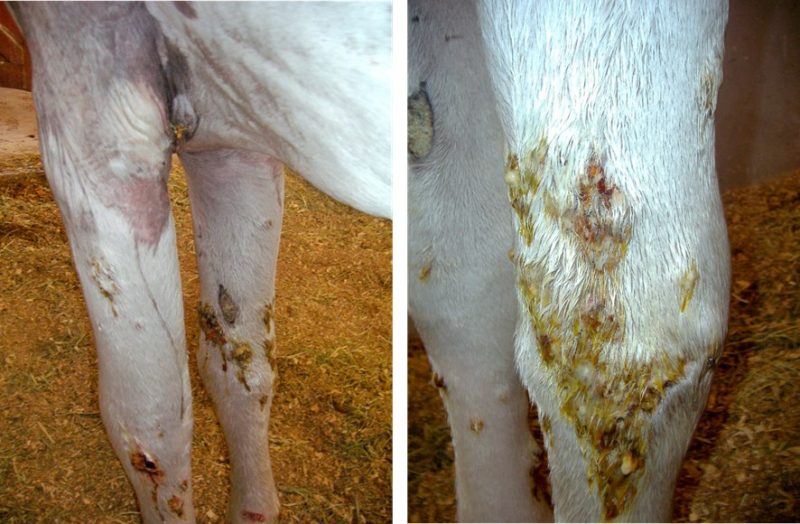
Horse. Cutaneous form of Glanders. Presence of subcutaneous nodules and thickening of the lymphatic vessels, some of which ulcerate and drain purulent material of yellowish color. Source: MerckVetManual.com Courtesy of Dr. Elisabeth-Lidwien Verdegaal, University of Adelaide.

Horse. Cutaneous form of glanders. Ulcerated cutaneous nodule. Source: WOAH

Horse. Cutaneous form. Cutaneous fistulas along the lymphatic vessels of the foot. Source: Vaina Santana. SVA.se.
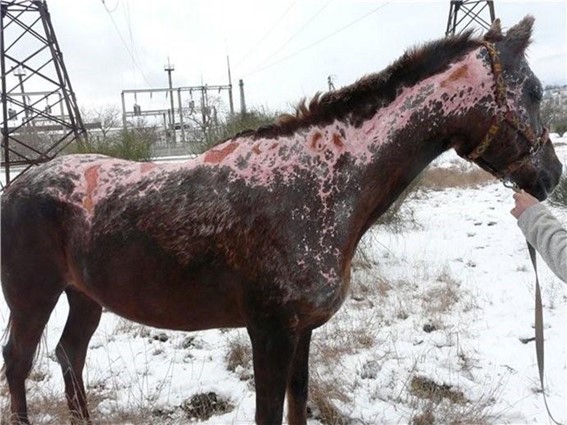
Horse. Chronic cutaneous form of glanders. Extensive scarred ulcerative lesions. Source: WOAH
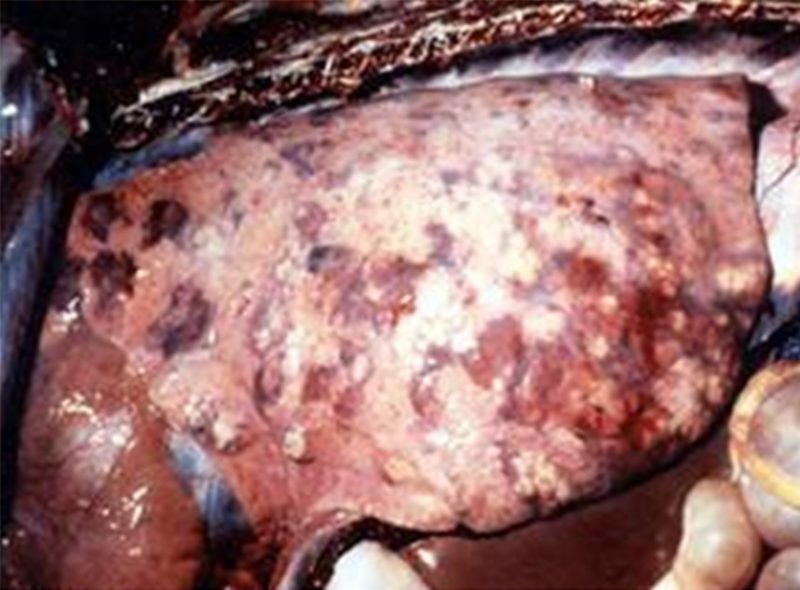
Donkey. Pulmonary form of the Borm. Extensive pneumonia with pyogranulomatous nodular lesions. Source: USAHA Foreign Animal Diseases (The Gray Book) at APHIS-USDA.

Horse. Nasal shape. Examples of lesions in the nasal mucosa. A) acute nodular lesions with ulcers of different sizes and b) chronic lesions with the characteristic star shape. Source: Acta Veterinaria-Beograd 2017 DOI: 10.1515/acve-2017-0045

Horse. Oral mucosa. Chronic star-shaped healed lesions. Source: Vaina Santana. SVA.se
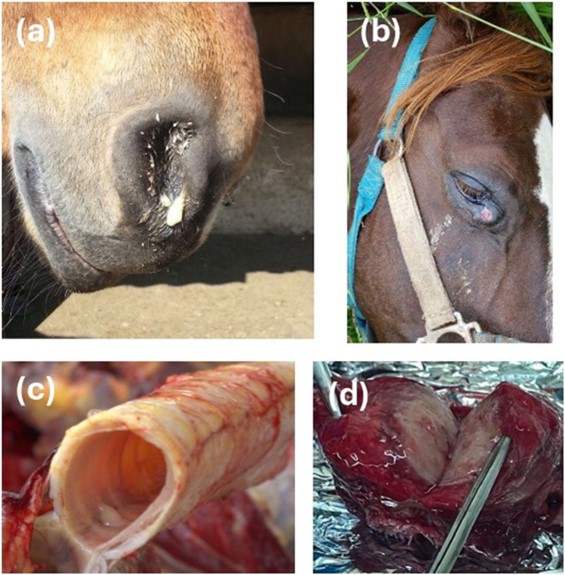
Horse. Glanders lesions. (a) Nasal mucopurulent discharge. (b) Periocular abscess. (c) Catarrhal exudate in the trachea. (d) Lung abscess. Source: Nassar et al 2025 J Equine Vet Sci