

Who bit these lambs?
A case was submitted to the SESC concerning a batch of 3-month-old crossbred lambs, in which 6 carcasses presented hemorrhagic lesions. The official veterinary service suspected dog bite wounds due to the distribution of the lesions and the presence of circular wounds resembling fang entry points.
One of the affected carcasses was received at IRTA-CReSA for further examination. Macroscopically, it showed very evident lesions consisting of muscular tears and hemorrhages, predominantly affecting the hind limbs, although also present in other locations. Multiple circular lesions (already observed at the slaughterhouse), compatible with fang wounds, were noted. In some cases, the musculature and fascia showed a roughened appearance with fibrin deposits, suggestive of penetrating skin injury and deep bacterial infection. Histological examination confirmed the presence of bacteria and suppurative inflammation. Microbiological cultures were performed on swabs collected from these regions, yielding growth of coagulase-negative Staphylococcus spp.
The appearance of the lesions (tears, circular wounds) and their pattern (predominantly on the hind limbs) are highly characteristic of dog bite injuries; however, they do not provide definitive confirmation. Dogs often bite several times in the same area, while wolves tend to bite and hold. For this reason, swabs were sent to the Veterinary Service of Molecular Genetics (SVGM, Faculty of Veterinary Medicine, Autonomous University of Barcelona -UAB-) to attempt detection of dog genome material in the potential saliva remains within the lesions. These swabs were collected from infected wounds, assuming that saliva traces would be more likely to be found where skin disruption had occurred. Of the 3 swabs analyzed, mitochondrial dog DNA was successfully detected in 2 of them (the PCR* assay used allows differentiation between dog, wolf and bear DNA). Therefore, it was genetically confirmed that the wounds corresponded to dog bites.
This case is a clear example of injuries caused by dogs (commonly shepherd dogs) when biting sheep. These animals may present only mild lameness, and no obvious abnormalities may be detected during ante-mortem examination. However, once the skin is removed, the severe underlying lesions become evident. Correct recognition is important for its animal welfare implications. If confirmation of dog bites is required, samples may be submitted to the SESC. The sample of choice is the skin from the bite areas, as this is where traces of dog saliva are most likely to be found. (AC)
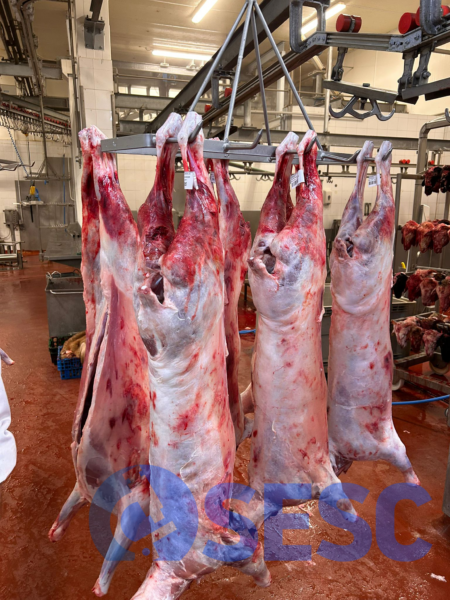
Slaughterhouse lamb carcasses with multiple lesions, mainly centered on the hind limbs.
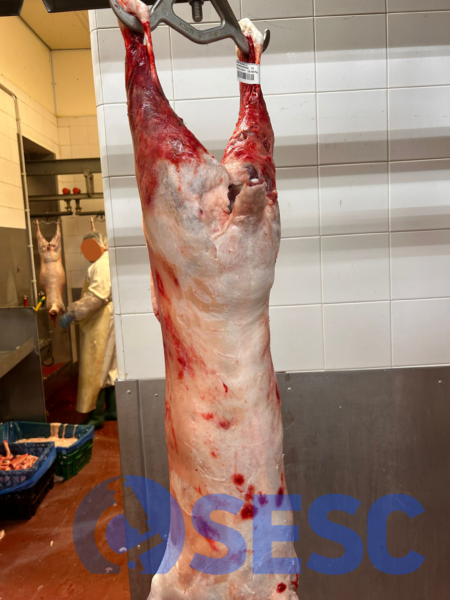
Lamb carcass showing lesions centered on the hind limbs.
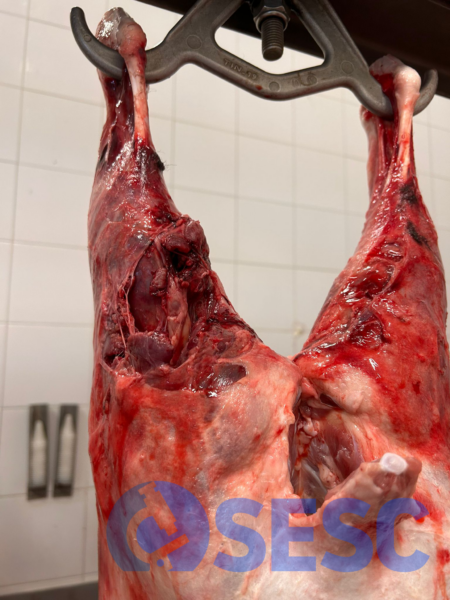
Closer detail of lesions on the hind limbs. Severe muscular tears with extensive associated hemorrhage are observed.
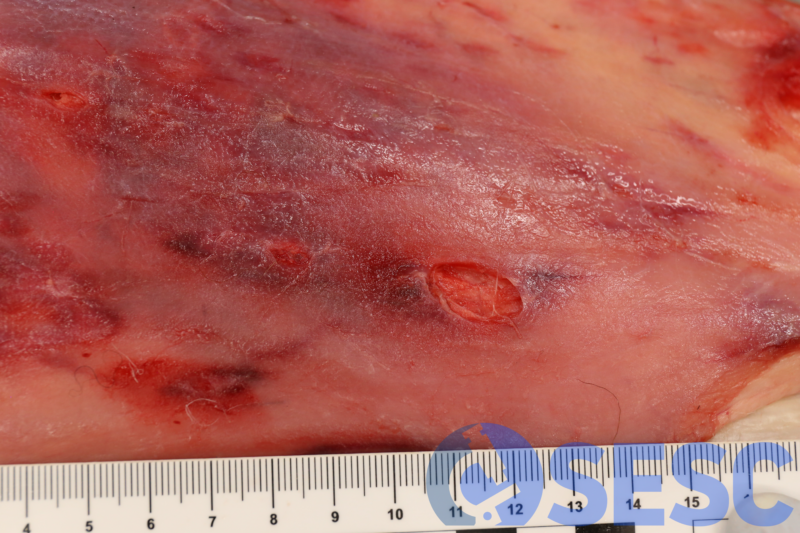
Detail of circular lesions corresponding to the puncture wounds caused by the dog’s fangs during biting.

Detail of muscular tearing, with a roughened surface and fibrin deposits (indicative of bacterial infection).

*The genetic analysis has been funded by the LoupO Coexistence project (EFA205/06) of the European INTERREG VI-A Spain–France–Andorra Programme (POCTEFA 2021–2027).

1 comment(s)
Interessant cas de determinació de l’autoria a través de l’ADN. Si el gos que ha infringit les mossegades ha estat el del propi ramat, no serveix per fer aquesta activitat i hauria de ser retirat. Si el gos que ho ha causat ha estat un tercer que ha entrat a l’explotació, això te altres implicacions legals que caldria esbrinar a través de les mostres restants de l’ADN.