

Annual summary 2024
During 2024, SESC has managed a total of 128 inquiries. Of these, 10 were online inquiries and the remaining 118 corresponded to requests for laboratory analysis of samples.
Below we present a summary of this year's data. We take the opportunity, once again, to thank the collaboration and effort of the pathologists and experts in animal health from both the IRTA-CReSA, the SDPV and the Faculty of Veterinary Medicine of the UAB as well as the staff of the Public Health Agency of Catalunya (ASPCAT), especially to the official meat inspectors who, with their contributions, make the success of this page and this service possible.

Evolution of the number of queries submitted to SESC.
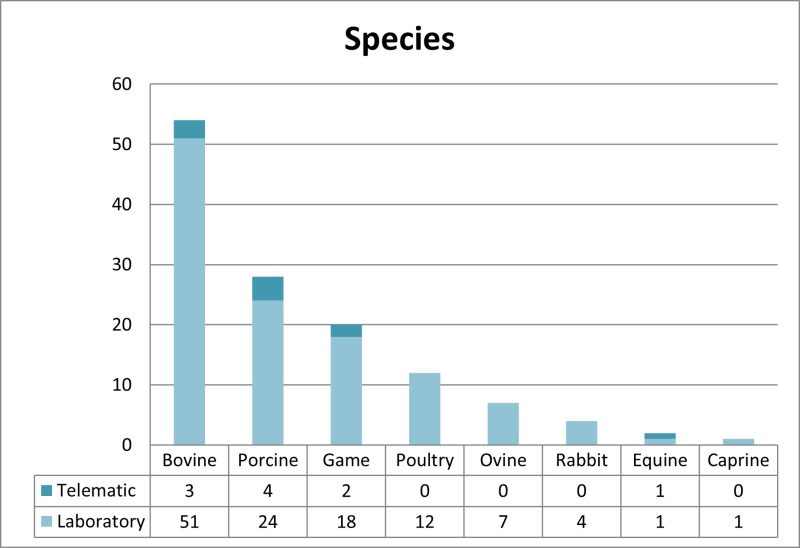
As usual, the beef sector contributes the largest number of inquiries. It is worth highlighting the increase in the number of consultations about game meat, largely due to suspicions of tuberculosis in wild boar.
Year 2024 has been a period of consolidation and improvement for the Slaughterhouse Support Service (SESC). The main milestone has been the update of the condemned visera and carcass log, a process that has involved the collaboration of experts from the SESC, official veterinary services (SVOs) and other ASPCAT staff, allowing the redefining of the classification categories of carcasses and viscera not suitable for human consumption. This review has facilitated a better understanding of the functioning of the SVOs and has guided the training needs of the sector.
- For example, we have identified that there is a probable overdiagnosis of porcine dermatitis and nephropathy syndrome (PDNS). Thus, one of the objectives for 2025 will be to collect images and samples of carcasses declared not suitable for human consumption due to PDNS with the aim of assessing whether they are being misdiagnosed and establishing criteria for their correct diagnosis.
- Another topic that we have dealt with during 2014 has been the study of joint lesions in cattle carcasses, which, when multiple, often generate doubts in the SVOs about whether it is advisable to make a total condemnation of the carcass due to generalized disease. Although this approach would be correct in the case of septic arthritis, we have been able to verify in the 5 inquiries that have arrived regarding this finding, that they were aseptic lesions, probable cases of osteochondrosis, a degenerative process that would not have implications for public health and that could be resolved with a partial condemnation of the carcass.
Regarding the inquiries, 128 cases have been managed, with 92.2% corresponding to requests for laboratory analysis. Also noteworthy is the study of 821 samples for the bovine tuberculosis eradication program, which has resulted in five positive diagnoses. Likewise, an increase in consultations related to game meat, especially wild boar, has been observed due to the detection of lesions compatible with tuberculosis. However, once again, we are below the target of remission of non-tuberculous granulomas in domestic species (only 15 bovine granulomas, far from the 100 that we proposed to achieve the target set by the MAPA and no suspicion of small ruminants). It must be emphasized that slaughterhouse surveillance is an essential piece to achieve the eradication of animal tuberculosis, especially in those domestic reservoirs where skin tests are not carried out.
Also noteworthy is the publication of six new entries in the Diagnostic Atlas and the 24 posts in this blog, a fundamental tool for training and scientific dissemination. In 2025, we set ourselves the goal of expanding the atlas especially in these species that have the lowest number of files.
Table 1: Summary of suspected notifiable diseases and zoonoses of the veterinarians submitting the samples and their alternative diagnoses.
| SUSPICION | Nº of inquiries | % Confirmation of suspicion | DIAGNOSES (Summary) |
| Lesions compatible with Tuberculosis* | 32 | 68.75% (22/32) | TB** 22 |
| Fungal lymphadenitis 3 | |||
| Chronic suppurative bronchopneumonia 2 | |||
| Mycobacteriosis (M. avium) 1 | |||
| Bacterial pyogranulomatous lymphadenitis 1 | |||
| Chronic fibrous serositis 1 | |||
| Necrotizing lymphadenitis (genus Mycobacterium) 1 | |||
| Probable parasitic granuloma 1 | |||
| Lesions compatible with Cysticercosis | 9 | 11.11% (1/9) | Bovine cysticercosis 1 |
| Eosinophilic myositis 3 | |||
| Myocardial infarction 1 | |||
| Cysticercus tenuicollis 1 | |||
| Subacute fibrinosuppurative pericarditis 1 | |||
| Chronic serositis 1 | |||
| Arteriosclerosis 1 | |||
| Lesions compatible with ASF/CSF*** | 14 | 0% (0/14) | No diagnosis 5 |
| Nonspecific hemorrhagic diathesis 3 | |||
| Septic process 2 | |||
| Nonspecific subcutaneous hemorrhage and superficial dermatitis 1 | |||
| Possible PDNS 1 | |||
| Infected skin wounds 1 | |||
| Hemorrhagic cystitis by C. perfringens 1 |
*This classification includes samples received in which, although the inspector did not suspect TB, the lesion was macroscopically compatible. **TB diagnoses correspond to 6 bovine LCT (4 confirmed CMT PCR/culture, 2 pending) and 20 wild boar LCT (20 confirmed CMT PCR/culture). ***In all cases, the infection was ruled out by molecular diagnosis (PCR) and histopathological study.
Table 2: Summary of the diagnoses.
| Classification | Diagnostic Summary | Frequency |
| Infectious | TB | 22 |
| n=45 | Infectious sinusitis (Mycoplasma gallisepticum) | 4 |
| Rabbit hemorrhagic disease | 2 | |
| Bluetongue | 2 | |
| Bacterial pyelonephritis | 2 | |
| Marek's disease | 2 | |
| Abscess disease or Morel's disease (S. aureus anaerobius) | 2 | |
| Bacterial arthritis (Staphylococcus aureus) | 1 | |
| Pleuritis due to Pasteurella multocida and Moraxella sp. | 1 | |
| Subcutaneous abscesses | 1 | |
| Bacterial pyogranulomatous lymphadenitis | 1 | |
| Avian pox | 1 | |
| Hemorrhagic cystitis due to C. perfringens | 1 | |
| CMA mycobacteriosis | 1 | |
| Non-TB necrotizing lymphadenitis (genus Mycobacterium) | 1 | |
| Bacterial endocarditis (Moraxella sp.) | 1 | |
| Inflammatory | Osteochondrosis | 5 |
| n=24 | Eosinophilic myositis | 4 |
| Chronic suppurative bronchopneumonia | 3 | |
| Septic process | 2 | |
| Subcutaneous hemorrhage and nonspecific superficial dermatitis | 1 | |
| Generalized arteriosclerosis (possible chronic PDNS) | 1 | |
| Chronic fibrous serositis | 1 | |
| Arteriosclerosis + salpingitis + oophoritis | 1 | |
| Subacute fibrinosuppurative pericarditis | 1 | |
| Muscle necrosis (due to medication?) | 1 | |
| Eosinophilic dermatitis and panniculitis | 1 | |
| Hepatitis + cholangitis + glomerulonephritis | 1 | |
| Chronic serositis | 1 | |
| Systemic mastocytosis | 1 | |
| Fungal | Fungal lymphadenitis | 3 |
| n=4 | Ringworm | 1 |
| Parasitic | Besnoitiosis | 4 |
| n=13 | Cysticercus tenuicollis | 2 |
| Suspected trichinosis | 2 | |
| Cysticercus pisiformis | 1 | |
| Demodectic mange | 1 | |
| Bovine cysticercosis | 1 | |
| Probable parasitic granuloma | 1 | |
| Inquiry about milk spot livers | 1 | |
| Neoplasia | Secondary hyperpigmentation due to ovarian tumors | 2 |
| n=7 | Sporadic bovine lymphoma | 1 |
| B-cell lymphoma | 1 | |
| Cardiac vascular hamartoma | 1 | |
| Myeloma | 1 | |
| Cutaneous melanomas | 1 | |
| Others | Alcohol-ether test (positive for carotenoids) | 8 |
| n=34 | No diagnosis/significant lesions | 8 |
| Nonspecific hemorrhagic diathesis | 3 | |
| Ovarian atrophy + egg retention | 1 | |
| Renal arteriosclerosis | 1 | |
| Subcutaneous hemorrhages | 1 | |
| Myocardial fibrosis | 1 | |
| Lipid infiltration of muscle tissue | 1 | |
| Pigment accumulation in fat (yellow rabbit) | 1 | |
| Infected skin wounds | 1 | |
| Myocardial infarction | 1 | |
| Jaundice | 1 | |
| Arteriosclerosis (in the myocardium) | 1 | |
| Possible rectal rupture with perirectal bacterial proliferation | 1 | |
| Subpleural pulmonary atelectasis | 1 | |
| Alcohol-ether test (inconclusive) | 1 | |
| Muscular lipomatosis | 1 | |
| Renal dysplasia | 1 |